
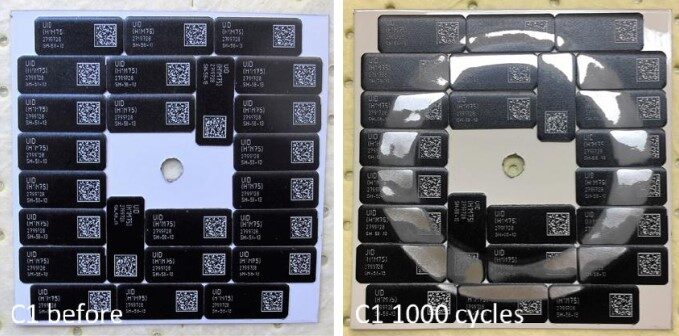
When organisations implement UID marking, focus is often placed on format, syntax, and compliance with MIL-STD-130. Data structure and verification are addressed early, but durability is sometimes treated as a checklist item rather than a lifecycle question.
A UID marking is not only expected to be correct at delivery. It must remain readable throughout the operational life of the product. That sounds straightforward, but durability requirements only make sense when they are linked to how the product is actually used.
Mechanical abrasion, temperature variation, moisture, chemicals, and handling all influence marking performance. However, test conditions can sometimes be significantly harsher than real operating environments. Abrasion tests, for example, may simulate extreme wear that the product will never realistically experience. The result can be that marking solutions are judged against requirements that are effectively over-specified.
This is where many projects drift into unnecessary complexity. If durability requirements are defined without a clear connection to lifecycle use, marking methods may be selected based on worst-case assumptions rather than realistic exposure. That can lead to higher cost, heavier solutions, or overly conservative choices, without adding proportional value.
Durability and verification are closely connected. A marking may remain attached yet show reduced contrast or grading after exposure. But the key question should always be: does the marking remain functional in the intended environment?
In the end, a compliant UID marking is not defined by surviving the harshest possible test scenario. It is defined by maintaining readability and traceability throughout its actual lifecycle. A structured interpretation of requirements, aligned with real operating conditions, helps ensure that durability supports traceability without driving unnecessary over-specification.