
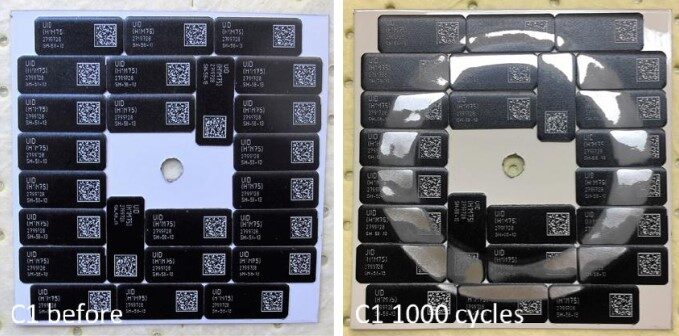
How durable is your UID marking — and does it really matter?

When organisations implement UID marking, focus is often placed on format, syntax, and compliance with MIL-STD-130. Data structure and verification are addressed early, but durability is sometimes treated as a checklist item rather than a lifecycle question.

A UID marking is not only expected to be correct at delivery. It must remain readable throughout the operational life of the product. That sounds straightforward, but durability requirements only make sense when they are linked to how the product is actually used.

Mechanical abrasion, temperature variation, moisture, chemicals, and handling all influence marking performance. However, test conditions can sometimes be significantly harsher than real operating environments. Abrasion tests, for example, may simulate extreme wear that the product will never realistically experience. The result can be that marking solutions are judged against requirements that are effectively over-specified.

This is where many projects drift into unnecessary complexity. If durability requirements are defined without a clear connection to lifecycle use, marking methods may be selected based on worst-case assumptions rather than realistic exposure. That can lead to higher cost, heavier solutions, or overly conservative choices, without adding proportional value.

Durability and verification are closely connected. A marking may remain attached yet show reduced contrast or grading after exposure. But the key question should always be: does the marking remain functional in the intended environment?

In the end, a compliant UID marking is not defined by surviving the harshest possible test scenario. It is defined by maintaining readability and traceability throughout its actual lifecycle. A structured interpretation of requirements, aligned with real operating conditions, helps ensure that durability supports traceability without driving unnecessary over-specification.


Data traceability in ILS training – from equipment to lifecycle insight

In complex defence systems, logistics and support are not secondary activities, they are part of the system itself. Equipment is transported, configured, maintained, replaced, and redeployed throughout its operational life. In this environment, data traceability becomes an operational capability rather than an administrative function.

Integrated Logistics Support (ILS) training increasingly reflects this reality. The entire lifecycle of defence systems depends on structured identification and traceable data. UID supports this by enabling individual tracking of equipment and components, but real value is created when data consistently follows the system over time.

A critical element is how maintenance activities are connected to specific equipment identities. Through Maintenance Task Analysis (MTA) training, both preventive and corrective actions are linked to uniquely identified items. When a technician replaces a spare part, the part is scanned in an electronic maintenance management system. The specific serial number is then connected to the product system’s digital logbook, ensuring that the recorded configuration matches operational reality.

This structured traceability strengthens auditability and regulatory compliance, while also enabling ILS engineers to provide data-backed feedback to designers early in the lifecycle. Over time, this reduces duplication of effort, improves reliability, and supports more informed lifecycle decisions.

In dynamic field environments where equipment is frequently moved and reconfigured, traceability creates the essential link between physical assets and digital records. When UID-based identification is integrated into ILS training and daily routines, traceability becomes embedded in the organisation’s way of working, supporting both readiness and long-term lifecycle control.

Why marking quality and verification matter more than you think

Product marking is often treated as a late step in the delivery process, but in many operational contexts it plays a critical role in identification, traceability, and serviceability. Poorly designed or poorly verified markings can lead to misidentification, scanning failures, and operational inefficiencies long after the product has left production.

Standards such as ISO/IEC 15415 define quality criteria for 2D codes like DataMatrix, but compliance alone is not always sufficient. Markings must also be designed for the real environment in which the product will be used. Factors such as surface material, wear, contamination, lighting conditions, and accessibility all affect long-term readability.

Verification should therefore be seen as part of quality assurance, not just as a formal requirement. By verifying marking quality early and understanding how markings perform in realistic conditions, organisations can reduce downstream issues related to maintenance, documentation, and product identification. In the long run, consistent marking quality supports more reliable traceability and reduces the risk of costly rework or customer non-conformities.

When does UID become relevant and what does it actually involve?

Unique Identification (UID) is often associated with defence and aerospace programmes, but the underlying need arises in many types of system deliveries. UID becomes relevant when individual identification of products or components is formally required, for example through customer specifications, contractual obligations, or regulatory frameworks.

In a typical UID implementation, each relevant item is assigned a unique identifier that remains stable throughout the product’s lifecycle. This identifier is physically marked on the product and represented in machine-readable form, often using DataMatrix codes. The purpose is to ensure unambiguous identification across documentation, logistics, maintenance, and configuration control.

The challenge is rarely the marking itself, but rather how UID is integrated into existing processes. Questions often arise around what level of the product structure should be identified, how identifiers are generated and managed, and how data quality is ensured over time. A controlled approach to UID focuses on interpreting requirements, selecting appropriate marking methods, and ensuring that the implementation is both compliant and practically usable in daily operations.